Food & Home

1- How did you get into producing honey?
Beekeeping has been a cherished hobby in my family for a number of generations. The annual family ritual of the opening of the garden hives in midsummer for the sharing of the bees’ spring bounty by taking their top 1/3 honeycomb, has always been to me one of the most cherished of my earlier memories. While quite frustrated by not being able to source the honey that my taste buds regarded as their ideal and consistently demanded, eventually I had to accept, quite happily I must add, that to solve it I had to have my own bees. It didn’t take all that long for the passionate hobby to become a full time job. Now, and not so jokingly I do tell people that “I am only the slave of my workaholic bees…’
2- Where do you source all of your honey from?
From my own bees and on a radius of around 250km from Johannesburg, I usually get an average of 7 types of honey. Further away and mostly due to the forbidding logistics, I have to rely on some friends and fellow beekeepers for the unique honey(s) that may exist in their specific areas. Needless to say that they must be known for their professional ethics. The honey I sell must be pure, unheated, non irradiated, as well as un-clarified or damaged in any way.
3- Tell me about some of the more unusual flavours/infusions in your range.
In South Africa we are blessed with an extraordinary floral and climatic diversity. With it comes a wide range of superb and unique honeys, namely Boekenhout, Buffalo Thorn, Sweet Thorn (Karroo Acacia), Black Thorn (Acacia Mellifera) Aloe (Davyana), Fynbos, Bush willow (Cumbretum), Avocado and a number of others. To obtain honey with flavours that are not possible directly from the hive, or for particular medicinal purposes, I infuse specific honeys with a wide range of herbs and spices or other natural products. From Cardamom and Cinnamon, to Lemon Grass and Anise, or my healthy and delicious version of marmalade, Mandarine Zest. I also make nut and chocolate spreads, i.e. Raw Honey, Raw Cocoa and Hazel Nuts, also with Macadamia or Almond.
4- What is your favourite way to eat honey?
Some honeys, namely Boekenhout, should be indulged by the spoonful as a most delectable crème brulee. Avocado or Sweet Thorn a must for yogurt. Buffalo Thorn great for porridge and together with Creamed Aloe, for mouth watering toast. For herbal tea definitely Black Thorn, Orange Blossom a blessing with hot scones and Bluegum a good jack of all trades, would do an excellent job for cooking and baking.
5- The strangest food combination that you’ve seen with honey so far?
Carpaccio marinated in Fynbos honey. Seen, tasted it and it was utterly scrumptious. Exactly like some other great recipes, it was the creation of a great chef (Stefano Strafella). (011 784 8580) Stefano also makes Quail in Mead (honey wine), literally to die for…
6- Besides being used in the kitchen, what else is honey good for?
These days honey is back as an essential medicine in hospitals, especially in Europe and namely in the treatment of burns, ulcers, including in the stomach and for healing in post facial reconstruction surgery. In water with a pinch of salt honey makes a most effective treatment for dehydration, including from dysentery. It is extensively used in cosmetic creams or just as facial masks.
7- Where are your products available?
Thrupps, the up market Johannesburg grocery store sells quite a number of my products. A few Health Shops to some extent, but mostly directly from my home (011 783 1993) – kim@thehoneybear.co.za
Dances with bees
Getaway.co.za
‘If you’ve never seen a cluster of beehives first thing in the morning, you’ve missed the eighth wonder of the world…. Fifteen metres away you will hear it, a humming that sounds like it came from another planet. At 10 metres your skin will start to vibrate. The hair will lift on your neck. Your head will say, “Don’t go any farther,” but your heart will send you straight into the hum, where you will be swallowed by it. You will stand there and think, “I am in the centre of the universe, where everything is sung to life.”‘
This passage from Sue Monk Kidd’s novel, The Secret Life of Bees, ignited a desire in me. I wanted to know the world where thousands of individuals produce the golden nectar of the gods, where the community is more important than the well- being of any single soul and a whole colony can communicate and collaborate through dance and scent. So I did what any semi-insane person would and went to find a beekeeper.
The messenger
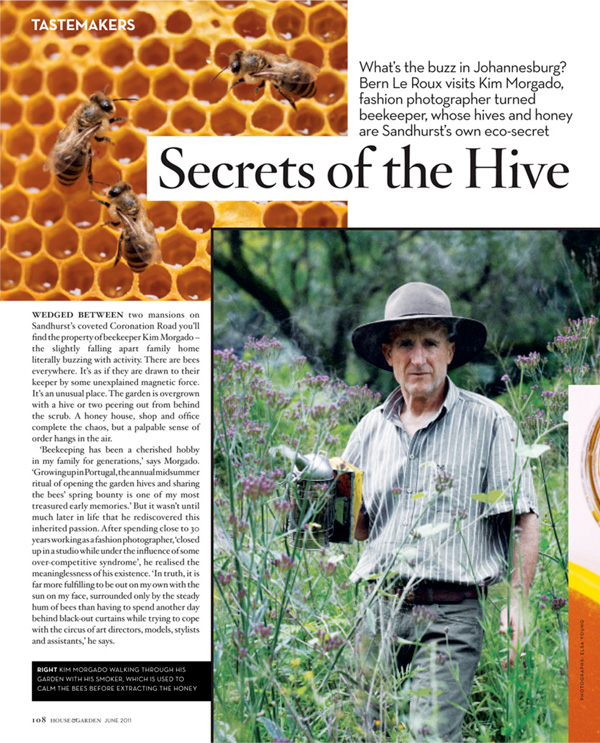
Kim Morgado, fondly known as The Honey Bear, grew up surrounded by beehives at his grandmother’s house in the south of Portugal. ‘When I came to South Africa, I became a fashion photographer, ‘he said in a lilting French-come-Portuguese accent, his mischievous eyes crinkling at the corners, ‘but all the time I was searching for the honey of my youth and couldn’t find it. I put a few hives in my garden and then, suddenly, there it was. That’s when I knew I had to have my own bees.’
He led the way to the back of his suburban Johannesburg home where the air hung heavy with a sugary scent. In his honey house, the walls were lined with jars of golden liquid, some dark as treacle and others glistening like cre`me caramel in the sunlight.
‘ There are the familiar favourites like blue gum and orange blossom,’ he said, his weathered hands rearranging some of the bottles, ‘and some more exotic, like black thorn, mesquite and saligna’. Honeycomb was cloaked in flowing silk and wooden frames stood like empty chests, waiting to be moved out and refilled with treasure.
The Honey Bear’s passion is spreading the gospel of the bees and the medicinal uses of their products. ‘Every fool has his quirk,’ said Kim as we headed for the north side of the Magaliesberg Mountains where the orange trees were in bloom, ‘and mine is beekeeping. I mean, what man chooses to spend his life alone at all hours of day and night in extreme temperatures with bees? I’m always at the mercy of my little workaholic friends.’
The bee-ennese waltz
We climbed out of the car in the middle of an orange orchard and walked down a row until big, brown wooden boxes came into view, perched under the lowest leaves. Every step for- ward was a resistant push against the warning words of my mother, ‘Be careful of bees.’ I recalled hearing that even large bull elephants run at the sound of bees swarming.
A steady, low hum filled the air and seemed to vibrate at a different frequency to anything my ears could understand. The sound of tens of thousands of bees made the hair lift on the back of my neck alright, but probably not in the way that Sue Monk Kidd had experienced.
Kim explained the set up of the hive. The bottom section is called the brood chamber where the queen and most of the bees are found. The upper part is made up of supers where the honey is created and stored. The small opening was a writhing, congested mass of little black and yellow bodies trying to enter or exit the hive against the traffic.
As we stood between two trees, individual worker bees hurtled past our ears on their way to forage. ‘Do you know how they direct each other to food sources?’ Kim whispered. ‘ They dance. They create movements and patterns in the air called round and waggle dances that help them to communicate how far the source is and in what direction.’
A worker was foraging nearby, darting from blossom to blossom. The scopa on her legs were bulging like enormous yellow pockets, stuffed full of pollen while she sucked on sweet nectar. Later it would be digested by other bees, then spread out in the honeycomb and fanned dry by the draft from thou- sands of tiny wings.
‘Are you ready to open up a hive?’ Kim asked. We kitted ourselves out in white protective suits, veils and gloves (the opposite colour to bees’ natural predators). Kim lit the smoker and we sauntered down the row, looking like two astronauts with a censer lost in an orchard. ‘Okay,’ said Kim, poised and ready to open a hive. ‘Remember, if they come for you, run through the bushes so they lose your scent and get to the car.’
He moved forward and blew smoke into the hive to calm the bees. It’s understood that, when they detect smoke, they prepare to evacuate the hive and eat as much honey as possible, which makes them lethargic and non-aggressive. The Honey Bear took hold of one of the supers and lifted it up, dripping with gold.
Dive bombers
I was enchanted, but the guard bees were not enjoying nor humouring our invasion. They blazed out of the hive, came straight for me and circled three times, warning me to back off. I hurriedly stumbled backwards away from the hive.
They still weren’t happy. I was under attack as they dive-bombed my head. The humming became a scream in my ears. I turned and made a dash for the car. Bushes, must run through bushes. I bobbed and weaved between trees, tripping over roots and getting smacked in the face by branches. I made it to the car and shut myself in, panting and heart pounding.
I looked back into the orchard, expecting to see Kim hot on my heels. But no, he was still happily tending to his hives. A black, vibrating mass grew around him without inciting so much as a flick of the hand. He closed up the last of the hives and waltzed merrily and easily between the trees in his white space suit.
The bees became fewer with every turn until he made it back with only one or two stragglers. In the car, he removed his veil, looked at me with a glint in his eye and asked, ‘Did they come for you? How many?’
‘Maybe three?’ I replied sheepishly.
‘Very good for your first time!’
I may not have made it to the centre of the universe, nor experienced the eighth wonder of the world in all its humming glory, but for every spoon of sweet deliciousness in my tea or bite of a honey-drenched pancake, I’m eternally grateful to the hard-working bees – and their keepers.
The Honey Bear
Kim Morgado sells a wide variety of honey, delicious spreads made of honey, nuts and chocolate, bee products such as propolis healing lotion, pollen capsules, sunscreen, bee venom, royal-jelly capsules and hand lotion. You can order his products and get more information on bees at tel 082-558-6666, e-mail kim@thehoneybear.co.za, web www.thehoneybear.co.za.
Honey is used by bees as a food source. For humans it’s commonly a sweetener, but can also be used for healing wounds and skin burns. It’s included in many cosmetic products because of its anti-microbial and moisturising properties.
Pollen is food for the bees and a supplement for people as it is rich in vitamins, minerals and protein (higher than beef).
Propolis is used to clean and repair the hive. It acts against bacteria, viruses and fungi. It’s a natural antibiotic and anti-inflammatory, with an anaesthetic effect.
Royal jelly is used as a high-protein food for growing larvae and the queen bee. The cosmetics industry adds it to products for its anti-bacterial properties.
Bee venom has a positive effect on rheumatoid arthritis, gout and multiple sclerosis.
Home & Garden